Vendor Consolidation Is Reshaping Biomedical Equipment Repair
Facilities are trading a pile of vendors for one accountable partner. Medical Field Service makes that simplification safe for biomedical equipment repair.
Everything Medical Field Service publishes on biomedical equipment repair in one place: the full service overview, the related services we provide, and the locations we cover.
This is the index for biomedical equipment repair. If you already know which service you need, go straight to it below; if not, the full overview explains what each one covers.
Repair starts with diagnosis, and diagnosis starts with the failure history. A device that has failed the same way three times has a root cause that replacing the same board a fourth time will not reach. The work is to find what is actually driving the fault, then fix that.
Findings are reported plainly, including the ones that mean a device should be taken out of service.
The parts decision is the honest part of a repair. Some faults justify an OEM part, some are served perfectly well by a qualified equivalent, and some devices are past the point where either makes economic sense. A technician should tell you which of the three you are looking at before the invoice, not after.
Turnaround matters more than list price on a repair. Equipment sitting on a bench is capacity a department does not have, so the useful question is not only what a repair costs but how long the device is out and whether a loaner bridges the gap.
Work is performed to manufacturer specification and the applicable regulatory standard, and the record says which one was applied.
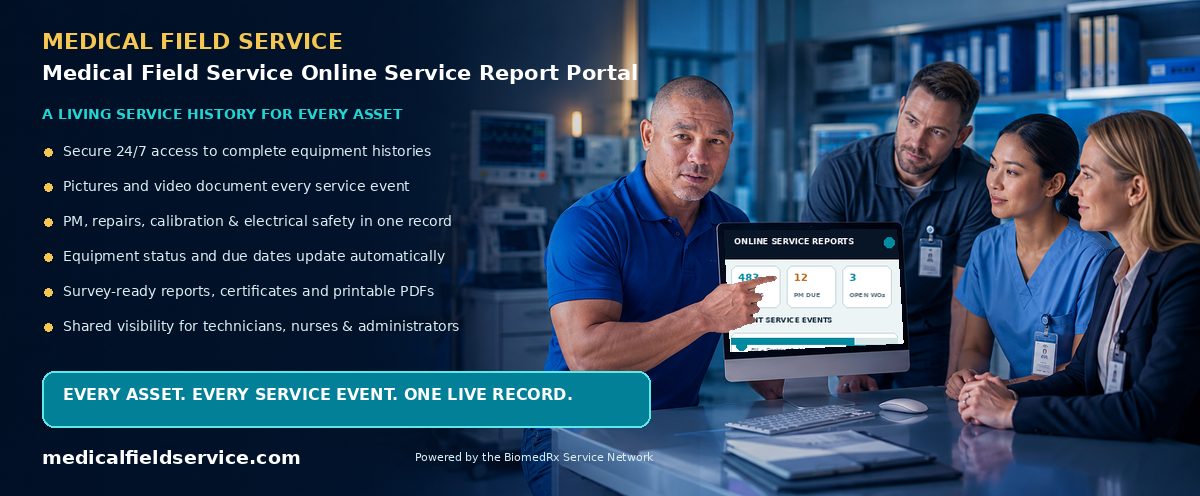
Every visit produces documentation an inspector can read without a translator: what was done, to what standard, by whom, and when it is next due.
Technicians are qualified for the equipment they touch, and the qualification is on file rather than asserted.
Turnaround matters more than list price on a repair. Equipment sitting on a bench is capacity a department does not have, so the useful question is not only what a repair costs but how long the device is out and whether a loaner bridges the gap.
A first visit starts with what is already on site: an inventory that matches reality, the service history that exists, and an honest read on which devices are worth continued investment. Nothing useful gets planned from a list nobody has verified.
A complete equipment history changes capital planning from an argument into an evidence question. Departments that can show failure rates and repair spend per device get replacement budget; departments that cannot, do not.
If you are not sure which of these pages applies to your equipment, describe the situation and a technician will tell you what the work actually requires rather than what the largest quote would cover.
Current developments in biomedical equipment repair, with sources for further reading.
Primary regulations and standards referenced on this page. Where a standard is published commercially it is named in full rather than linked to a copy.